![]() |
||
![]() Coral Reef EchinodermsCoral reef echinoderms (Phylum Echinodermata) include a variety of familiar marine creatures that one would not recognize as close relatives. The name "Echinoderm" literally means "spiny-skinned", a trait that shared by all members of the group. Here, we shall briefly introduce the five most common types found in coral reef environments. These are the sea stars, brittle stars, sea cucumbers, sea urchins, and crinoids. Sea StarsSea stars (Class Asteroidea), also commonly called "starfish", are coral reef echinoderms most often found in sand and seagrass areas around reefs, where they prey on mollusks.
Crown of Thorns sea star preying upon hard coral polyps. © Fotolia
However there are exceptions. Some sea stars are commonly found on the reef itself, where they prey on other invertebrate animals including hard corals. During the 1970s, a "plague" of the coral polyp feeding "crown of thorns" starfish (Acanthaster planci, pictured left) ravaged coral reefs throughout much of the Indo-Pacific. Then, as suddenly as the outbreak began, it abated. Sea stars are able to move slowly about the reef or other benthic substrates through the use of numerous specialized appendages called tube feet located under each of the arms. Brittle StarsThe smaller brittle stars (Class Ophiuroidea) are common coral reef echinoderms closely related to sea stars.
Brittle star. © Fotolia
These animals can occur in very large numbers in certain reef habitats. They are able to move across benthic substrates surprisingly rapidly by wriggling their long, slender and highly flexible arms. Brittle stars are mainly nocturnal predators that remain sheltered by day, often buried in bottom sediments or within the cavities of sponges. They feed in a variety of ways, as scavengers, predators, and detritivores. Sea Cucumbers
Sea Cucumber © Istockphoto
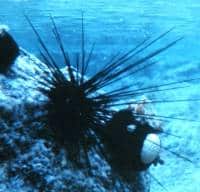
Sea cucumbers (Class Holothuroidea) do not resemble any other coral reef echinoderms, and would superficially appear to be of another lineage entirely. They possess elongated tube-like bodies covered in leathery skin. Holothuroids living within coral reef ecosystems mainly inhabit sand and seagrass habitats. They ingest enormous quantities of sediments from which organic nutrients are removed. Sea UrchinsThe familiar sea urchins (Class Echinoidea) are active herbivores and are among the most common coral reef echinoderms; they are found in virtually all reef habitats.
Sea urchin. © Fotolia
Some live in seagrass meadows of the back reef zone, while others shelter in crevices on reefs by day, emerging to actively forage on the reef itself or in nearby sand or seagrass habitats by night. During the 1980s, a widespread decline of the long-spined sea urchin (Diadema antillarum) was reported from a number of Caribbean reef locations. This population "crash' was blamed by some for the decline of live coral cover that occurred in the Greater Caribbean region during about the same period. However, no solid evidence of a direct cause-and-effect relationship has been as yet produced. As with the Acanthaster plague that ravaged Pacific reefs (see above), the question of whether such widespread population fluctuations might be due to human impacts or simply natural long-term cyclical events has not been resolved. CrinoidsCrinoids (Class Crinoidea) are delicately structured planktivorous echinoderms. They occupy a wide depth range in coral reef ecosystems, becoming more common in deeper waters of the lower reef face.
Feather star growing on a coral reef. © Fotolia
This ancient group of animals dominated shallow seas of the Paleozoic period but came close to extinction some 250 million years ago, along with most other species alive at that time. There are two basic types of crinoids. Sea lilies are stalked crinoids that live sedentary lives attached to the sea floor, where they filter plankton from the passing water. Most species of sea lilies live in very deep water well beyond the range of hard coral growth, but some inhabit deeper portions of coral reef ecosystems. Today, sea lilies are the only remaining echinoderms that live as attached suspension-feeders. The second type of crinoid are the feather stars. These are unstalked forms that appear somewhat more similar to sea stars than do sea lilies. Feather stars are not totally sedentary as are sea lilies, but rather are capable (as are sea stars) of slowly creeping about benthic substrates through the use of specialized structures. |
|
|
|
||
|
|
||