Belize Diving

Belize diving is unique among Caribbean dive vacation destinations aimed at exploring coral reefs. It is the only nation in the entire Tropical Western Atlantic region to contain a true barrier reef and several true atolls.

The combination of the unrivaled variety of major reef types, along with its position near the center of marine biodiversity for the entire Greater Caribbean region makes Belize diving a truly one-of-a-kind Caribbean diving experience.

There are two broad options from which to choose when it comes to exploring the coral reefs of Belize:

  • Belize Barrier Reef
  • Belize atolls


The Belize Barrier Reef

The Belize Barrier Reef System is exceptionally rich and diverse. This 200-mile long structure runs parallel to the Belizean mainland at distances averaging about 15-25 miles offshore.

the inner margin of the Belize Barrier Reef system, with seagrass meadows and patch reefs in foreground
Inner margin of the Belize Barrier Reef system. © Fotolia.com

Predictably, Belize diving on the Barrier Reef system is best when winds are calm. Because of its exposed position to easterly winds, visibility tends to get poor (20-30 feet) during high wind conditions. Water temperatures are fairly constant all year lying between the mid 70's to mid 80's. A lightweight wetsuit is generally suitable for most Belize diving.

In 1982, the Smithsonian Institution sponsored a comprehensive study by a diverse group of marine scientists who conducted a thorough study of this reef system. These experts divided the barrier reef complex into three provinces: northern, central, and southern.

They concluded that the central province (popularly known as the "Middle Cayes"), contains the most spectacular reef development, with over 50 miles of well-developed barrier reef, mangrove islands, patch reefs, and seagrass beds.

Belize diving on the Barrier Reef system
Diver exploring the Belize Barrier Reef. © IStockphoto.com

More than 65 hard coral species have been identified on the Barrier Reef , which represents about 90% of the total number of hard coral species found in the entire Greater Caribbean region.

Likewise, an unparalleled (for the region) diversity of fishes, octocorals, and invertebrate animals has been recorded here. The Belize Barrier Reef was named a UNESCO World Heritage Site in 1996 as the largest barrier reef in the northern hemisphere.

Unfortunately however, there are clear signs of danger in this coral paradise as pressures on the barrier reef system steadily mount from a broad range of impacts that threaten the ecological integrity of this unique ecosystem.

Most notably, these include over-exploitation of reef resources by over-fishing and tourist development, unchecked coastal development, sedimentation, and pollution. Together, these factors have already damaged an estimated 40% of the Barrier Reef ecosystem, and in 2009 UNESCO added the Belize Barrier Reef to its list of world heritage sites in danger.

The bottom line is that although Belize diving still ranks among the best of Caribbean coral reef diving destinations, divers need to choose their dive sites carefully these days to avoid those reef areas that have already succumbed to the onslaught.

Where to Stay To Dive The Belize Barrier Reef

The most popular Belize diving destination by far on the Barrier Reef is Hol Chan Marine Reserve, located some 4 miles southeast of Ambergris Cay, the northernmost point of the barrier reef system within Belize territorial waters.

However, Hol Chan receives over 30,000 visitors a year and is showing clear signs of stress from this level of tourism and diving pressure, and the associated infrastructure that supports it. Ambergris Cay, the main gateway to Hol Chan, now has over 100 hotels and a new casino.

In our opinion a better option for exploring the wonders of the Belize Barrier Reef are the small resorts situated along the Middle Cayes, south of Columbus Reef and east of the coastal town of Dangria. The spur and groove systems and spectacular drop offs of the fore reef here provide the best and most unspoiled readily accessible diving to be found along the barrier reef.

small island located on the edge of the Belize Barrier Reef
Small island resort on the edge of the Barrier Reef. © IStockphoto.com

A number of very suitable but modest Belize diving resorts can be found on Tobacco Caye, a small island on the Barrier Reef just east of Dangriga. Here, "resort" means a few beach cabanas and a restaurant and (in some cases) a dive shop. There are no spas, shopping, or outside (the resort) restaurants.

For those wishing to dive this area but also stay in more luxurious accommodations, there are a few upscale resorts located near Dangria on the mainland. These offer daily dive trips to the barrier reef, along with the additional amenities of a first-class resort and easy access to other local attractions such as the city of Dangria and nearby rain forests.

The downside (for some) to staying at mainland resorts when planning numerous offshore dives are the lengthier boat rides to and from the best dive sites. Still, there are worse ways to spend your time than cruising the protected waters shoreward of the Belize Barrier Reef.


Glover's Reef (Atoll)

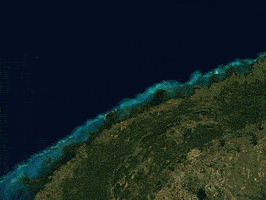
The atoll known as Glover's Reef lies some 45 km from the mainland and approximately 50 miles from Caye Caulker on the barrier reef.

Glover's Reef from space
Glover's Reef from space. Courtesy NASA

The atoll is roughly ellipsoidal in shape, extending about miles 15 miles in length and about 6-7 miles in width with a central lagoon area that totals about 80 square miles. The lagoon is relatively shallow, and contains some 700 patch reefs.

Glover's Reef is widely considered the best developed atoll in the entire Caribbean region. It is the most remote island group in Belizean waters, and experiences less human contact than Belize's two other atolls.

Not surprisingly, Glover's Reef offers the best and most varied of all Belize diving opportunities to observe healthy and rich coral reef atoll life.

Glover's Reef has been illegally fished by Guatemalan and Honduran fishermen for many years, and populations of conch and spiny lobster have been depleted in many areas.

However, the atoll was designated a National Marine Reserve by the Belize government in 1993 and a World Heritage Site by UNESCO in 1997. About 30% of the atoll's waters are zoned as a "no take zone", and are now actively patrolled by Rangers from the Belize Fisheries Department.

Where To Stay To Dive Glover's Reef

The six cays of Glover's Reef Marine Reserve are privately owned. There are dive 'resorts" on several of the largest of these. There are an abundance of patch reefs to snorkel or dive within the lagoon, and spectacular 3,000 ft. walls right offshore the local dive resorts.

Keep in mind that by "resort" in the context of this isolated atoll we refer to what might more appropriately be called an "adventure eco-tourism" lodge. These are rustic accommodations as one should expect at locations like this that are cut off from the main power, water, and communication networks of the mainland.

Do not expect private flush toilets or showers in each room, air conditioning, etc. at most of the atoll's resorts, although at least one provides some of these amenities.

Nonetheless, the quality of the Belize diving here more than compensates for what some travellers might call a bit of "roughing it". The rooms are generally clean and comfortable, the food is fresh and excellent, and the sense of privacy and natural beauty unmatched.


General Belize Diving Travel Information

Belize is the northernmost of the countries of Central America, bordering the Caribbean Sea between Guatemala and Mexico. It is the only country in Central America without a Pacific Ocean coastline.

Most of the mainland is covered by flat coastal swamps that gradually change to low mountains in the south. English is the official language, although Spanish is also widely spoken.

Belize is a bit over a 2-hour flight from Miami or Houston. At last report direct flights were also available from Los Angeles, New York, Atlanta, Washington, D.C. and Toronto, Canada. Airline tickets are normally cheaper if purchased online well in advance of your planned trip, especially if you will be travelling during the peak season of January through May.

For Belize diving vacationers travelling to the Barrier Reef resorts on the Middle Cayes, direct connections to Dangriga are available from Belize International Airport on Maya Island Air or Tropic Air. The flight is approximately 20 minutes, typically in a 14-passenger plane.

Alternately, you can take a 2-3 hr scenic drive to Dangriga and avoid the weight restrictions imposed by the Maya Island Air and Tropic Air operations, which can result in any of your baggage that exceeds the 40 lbs weight restriction (very typical for scuba divers) arriving on a later flight.

The resorts on Glover's Reef usually include boat transportation to the atoll directly from the port at Belize City as part of the package price.


DIVE CORAL REEFS (CARIBBEAN): SECTION NAVIGATION MENU

Saba Diving | Belize Diving| Bonaire Diving


Recommended Reading award from The Reef Tank


ezine expert author banner


Buzzle Author banner


safesearch logo


Home


CORAL REEF BASICS

Coral Reef Formation

Coral Reef Distribution

Types of Coral Reefs

Coral Reef Biome


CORAL REEF LIFE

Coral Reef Fishes

Coral Reef Animals

Coral Reef Plants

Coral Reef Food Web


EXPLORE CORAL REEFS

Dive Coral Reefs

Best Caribbean Snorkeling

Protecting Coral Reefs


Valid HTML 4.01 Transitional


Copyright 2009-2010. Coral-Reef-Info.COM. All Rights Reserved.