Coral Reef Animals
Coral reef animals are the most conspicuous component of coral reef life, occurring in truly astounding numbers and variety throughout the reef ecosystem.
Unlike terrestrial forests and prairies whose structure is formed by plants, it is animals (coral polyps) that actually form the structural foundation of coral reef ecosystems – as well as being its dominant inhabitants.
Two major groups of animals inhabit coral reefs: animals with backbones (called vertebrates) and those without these structures (called invertebrates).

Vertebrate Coral Reef Animals
Among vertebrate animals, only a relative few groups contain species that are regularly found within coral reef communities. These are:
- Fishes
- Sea Snakes
- Sea Turtles
- Dugongs and Manatees
Of these, it is only the fishes that are normally present in great numbers or variety. Because of their diversity and importance to ecosystem function we devote an entire page to coral reef fishes elsewhere on our website, and do not discuss them further here.
Sea Snakes
There are between 55-65 recognized species of sea snakes, but of these only a relative few are commonly found in coral reef areas.
Sea snakes have evolved from terrestrial snakes, and like all reptiles are air breathers. Specialized adaptations for aquatic life include paddle-like tails and laterally compressed bodies, both of which enhance swimming ability.
Sea snakes are found only in the Indo-Pacific region (excluding the Red Sea). Many species are highly venomous, and should never be closely approached or threatened by coral reef divers or snorkelers.

Sea Turtles
Of the seven recognized species of sea turtles, three are regular or occasional visitors to coral reefs in some parts of the world. Due to loss of nesting habitat and over-harvesting, all three species are now considered either threatened or endangered.
On both Indo-Pacific and Caribbean reefs, the species most often seen resting on the reef proper is the Hawksbill turtle Eretmochelys imbricata, a species that also feeds in the lagoon or back reef zone of coral reef ecosystems.
The green sea turtle (Chelonia mydas) also frequents coral reef ecosystems of both the Greater Caribbean and Indo-Pacific regions. This species feeds primarily on the seagrasses found in protected back reef lagoons.
The flatback turtle (Natator depressusis) spends much of its time in the open sea, and is only seen in coral reef areas in a few parts of the Indo-Pacific region; most notably coastal waters of Indonesia, northern Australia, and Papua New Guinea.

Dugongs and Manatees
Dugongs (Indo-Pacific) and manatees (Caribbean) were once plentiful in coral reef lagoons.
These peaceful giants – related to elephants – consume prodigious quantities of seagrasses, and were presumably the most prolific herbivores in coral reef lagoons prior to recent levels of human interference with these ecosystems.
Over the last two or three centuries however, extensive hunting, habitat loss, and coastal pollution have contributed to the rapid decimation of these animals. It is feared that they may soon become extinct.

Vertebrate Visitors
Several other types of vertebrates are occasionally seen hunting or feeding in waters around coral reefs.
However, these sporadic visitors spend most of their life cycles in other habitat types and are therefore not generally considered member of coral reef communities.
The most common of such transients and visitors are dolphins, porpoises, and sea birds.

Invertebrate Coral Reef Animals
Among coral reef animals, invertebrates (animals without “backbones”) are by far the most diverse and numerous. They are the primary builders of coral reefs and an integral part of almost every aspect of the ecology of coral reef ecosystems.
Even a summary treatment of what is currently known about the amazing variety of form, life histories, behavior, and ecology of invertebrate animals living in coral reef habitats would fill many volumes, and a great deal remains to be learned in this area.
The coral reef invertebrate animals we briefly introduce below are the:
- Sponges
- Echinoderms
- Mollusks
- Crustaceans
- Polychaetes
Another key group – the corals and their relatives – are instrumental in building the reef and are discussed along with the coral reef biome.

Sponges
Sponges are primitive, sedentary animals that filter feed on tiny food particles carried in the water sweeping over them. Coral reef sponges commonly exhibit one of three different body forms:

Vase sponges rise from the reef substrate as irregular, somewhat spheroid structures with large central cavities. The largest are usually found in deep water, and some have internal spaces big enough to contain a fully-equipped scuba diver.
(2) Tube sponges exhibit a branched body form. They tend to be highly colorful, with many species display brilliant yellow, orange, or reddish hues. Tube sponges are common in both shallow and deeper portions of coral reef ecosystems. Some species grow quite large, while others are fairly small.
(3) Encrusting sponges form a comparatively thin but often expansive layer atop reef substrates. They also often cover reef surfaces in crevices between coral colonies. Like tube sponges, these forms are often brightly colored, displaying a variety of hues in the yellow to red range.
Echinoderms
The name “Echinoderm” literally means “spiny-skinned”, a trait that shared by all members of the group. These are unusual animals, protected be a series of external skeleton made up of hard plates. Echinoderms also display “radial symmetry” – that is there is no “front” or “back” end.
Of the five distinct types of echinoderms that can be found on and around coral reefs, we here briefly describe the two that are generally the most common and that have the greatest influence on reef ecosystems; sea stars and sea urchins (Class Echinoidea).
Sea stars (Class Asteroida)- These animals, also known as “starfish”, are often found in sand and seagrass habitat around coral reefs as well as upon the hard reef substrate. As with echinoderms in general, these animals are able to move slowly about the reef or other benthic substrates through the use of numerous specialized appendages called tube feet located under each of the arms.
Most sea stars prey heavily upon mollusks, but there are exceptions. Some species hunt upon the reef itself, where they prey on other invertebrate animals including hard corals.
Over the past 50 years, sporadic outbreaks of the coral-feeding “crown of thorns” starfish (Acanthaster planci, pictured right) have periodically ravaged coral reefs throughout much of the Indo-Pacific.

Sea Urchins (Class Echinoidea) are active grazing herbivores and are among the most common of all coral reef echinoderms. Some live in seagrass meadows of the lagoon, while others shelter in crevices on reefs by day, emerging to actively forage on the reef itself or in nearby sand or seagrass habitats by night.
During the 1980s, a widespread decline of the long-spined sea urchin (Diadema antillarum) was reported from a number of Caribbean reef locations. This population “crash’ was blamed by some researchers as the primary cause of the noticeable decline of live coral cover that occurred in the Greater Caribbean region during the same period.
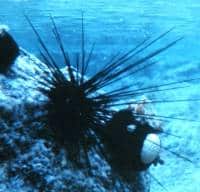
However, a number of other factors have also been proposed that may have caused or contributed to Caribbean coral declines over the past 5 decades and the actual contribution of sea urchin “die-offs” to these declines has yet to be firmly established.
Mollusks
Coral reef mollusks are mainly benthic (bottom dwelling) invertebrates, but there are a few open water swimmers included as well. Three classes of mollusks are common in coral reef ecosystems:
- Gastropods (snails, chitons, nudibranchs)
- Bivalves (clams, mussels, scallops)
- Cephalopods (squid, cuttlefish, octopus)

Gastropods
Gastropods are mostly herbivorous marine snails – slow-moving benthic grazers with a one-piece shell. Most species are small, and are usually well camouflaged or well-hidden.
Not all gastropods are plant-feeders however; some are active and voracious predators of other small invertebrates. For example, a group of predatory snails called cone shells contains species that have the capacity to inject a neurotoxin that can be lethal to much larger animals, including humans.
Bivalves
Bivalves have a shell composed of more or less equal halves. These are active filter feeders, pumping water through strainers to remove food.
The most frequently encountered of this group are the clams and scallops, which are not uncommon on the reef proper as well as in nearby sand and seagrass habitats. Bivalves depend upon concealment and the heavy shell to keep predators at bay. Nonetheless they are heavily hunted by reef fishes and sea stars.
The giant clams (Tridacna spp.) of the Indo-Pacific are the largest and undoubtedly the best-known of all bivalve coral reef reef mollusks. These animals have been overharvested in recent years, and are becoming increasingly rare.

Cephalopods
Cephalopods (squid, cuttlefish, octopus) are among the most highly advanced of all invertebrate animals. These swift, intelligent predators have well-developed nervous systems complete with relatively large brains and eyes very much like our own.
Cephalopods are distinguished by their many tentacles, which number eight in octopi, and ten in squids and cuttlefishes. They are masters of color change and are capable of complex behaviors.
Squid and cuttlefish are the only coral reef mollusks that feed as free-swimming, open water hunters.

Crustaceans
Coral reef crustaceans include the large, more familiar animals such as shrimps, lobsters, and crabs, as well as many smaller or cryptic types like amphipods, stomatopods, and copepods.
Like their land-based relatives the insects, crustaceans have an external jointed skeleton and numerous paired appendages that function in locomotion, feeding, and in a sensory capacity.
Crustaceans play a host of different roles in the ecology of coral reef communities. Some are scavengers, cleansing the reef of decaying animal remains. Others are active predators or omnivores. Many are preyed upon by coral reef fishes.

Here, we introduce three of the larger, more common reef crustaceans.
Spiny Lobsters
Spiny Lobsters (Panulirus spp.), long considered by many the premier delicacy of the tropics, are probably the best-known and most sought after of all coral reef crustaceans.
They are not full-time reef residents, but rather visitors that spend a good part of the year in deep benthic habitats distant from reefs. Nonetheless, at times their numbers in reef areas are substantial.
Typically, spiny lobsters remain safely positioned by day in cracks and crevices within the reef, with only the slowly waving antennae protruding. At night, they wander about more freely.

Shrimps
Shrimps are common coral reef crustaceans that come in many sizes and colors. They represent an important food source for a number of reef fishes.
On coral reefs, some shrimp species called “cleaners” play a highly significant role in the life of the coral reef community, gaining food by removing parasites from fishes or other invertebrates. Because of these benefits, the host grants them a special “protected” status.
Cleaner shrimp can be distinguished from most other types of shrimps by their particularly long antennae (see photo, right).

Crabs
Crabs that dwell on reefs generally remain well hidden within the reef structure by day.
Most are omnivores, feeding on a wide variety of food items including algae, worms, mollusks, bacteria, other crustaceans, fungi, and even detritus.
Certain types of crabs may play a more prominent role in coral reef health than previously suspected. They do this by acting as “cleaners” of hard coral colonies, removing and thereby reducing the numbers of infesting parasites and other harmful organisms from the bodies of their hosts in much the same way that cleaner shrimp benefit certain fishes.

Polychaete Worms
Polychaetes (Cl. Polychaeta) are distinctive worms bearing many “bristles”. These animals are common on the hard reef framework as well as within seagrass meadows, mangrove forests, coral rubble, and sand plains.
Polychaetes play a variety of roles in coral reef ecosystems.
Some types represent an important food source for other animals, particularly reef fishes. Others participate in the processing of sediment detritus and the erosion of dead coral.
Some polychaetes are sedentary (sessile), while others are motile and move about freely. The notorious fire worms and bristle worms are (at least to scuba divers) are among the most familiar motile polychate worms because they are quite painful to the touch.

Join Our Mailing list
Get updates via email on all things coral.