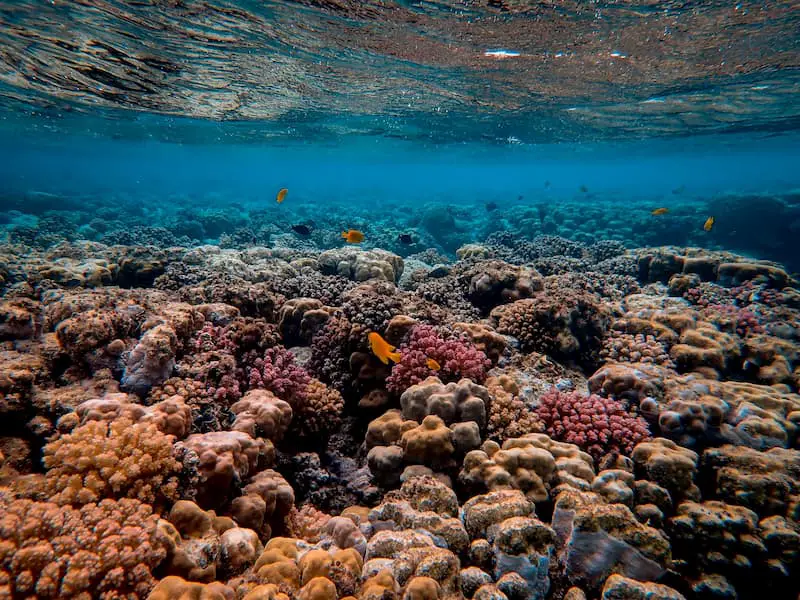
The coral reef food web - like those of all highly diverse ecosystem-types - is exceedingly complex.
Because so many species are part of these biological communities, any attempt at a comprehensive depiction of a coral reef food web would be futile.
Instead, we will simplify our task by restricting our discussion to an overview of the more common types of reef dwellers involved at each of three basic steps (trophic levels) in the food web.
Food Webs and Food Chains: What's the Difference?
A food chain is a single biological pathway of materials and energy (in the form of "food") leading from its origin within an ecosystem (usually a producer species) to a final consumer. For example, a red-tailed hawk may feed on rabbits, which in turn feed on small plants. That would be a food chain with three "links".
In contrast, a food web is a depiction of all feeding linkages among species within a biological community; essentially a diagram of "who eats whom" involving all the species present. So, a food web consists of ALL the food chains within an ecosystem.
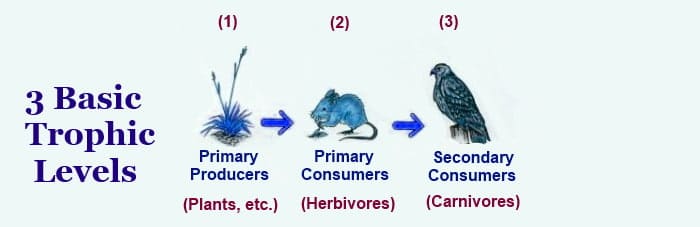
Most complex food webs, including that of the coral reef, can be seen as consisting of several basic "levels". Typically, either three or four such levels are distinguished (see diagram below).
Usually, each level is represented by multiple species within any given ecosystem. The most basic of these trophic levels are commonly called (from lowest to highest):
- Producers (plants)
- Primary Consumers (herbivores)
- Secondary Consumers (carnivores)
In general, for coral reef food webs it is somewhat simpler to consider only these three basic trophic levels. However, for some of the component food chains within the coral reef food web, a fourth level - tertiary consumers (top predators) - can also sometimes be readily distinguished.
Producers: Plants and Other Photosynthesizers
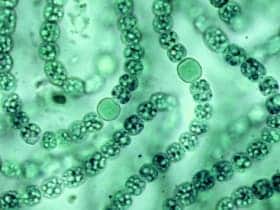
Three major groups of photosynthetic organisms - plants, algae, and bacteria - contribute to net primary production (creation of "new" organic compounds) within most coral reef ecosystems. The general biology and ecology of these primary producers are discussed on our page dealing with coral reef plants.
One group of photosynthetic algae - the zooxanthellae - deserves special mention in the context of understanding coral reef food webs. These single-celled organisms are not plants, but rather "protists" (members of the Kingdom Protista).
Zooxanthellae are extremely numerous and important in the context of primary production on coral reefs because they are symbionts that live within the animal tissues of coral polyps.
These essential biological partners provide corals with vital nutrients produced through photosynthesis. In return, the plant cells gain the benefits of refuge from hungry predators as well as a ready source of otherwise scarce nutrients produced by the coral's metabolism.
Plankton: Contributions From the Open Sea
Producers are not the only input of "new" food for coral reef food webs. A quite different neighboring marine biome - the open sea - also provides coral reef dwellers with substantial amounts of newly acquired energy and nutrients.
By far, the vast bulk of plant life in the sea is composed of microscopic planktonic algae (phytoplankton) that comprise the base of the entire marine food chain.
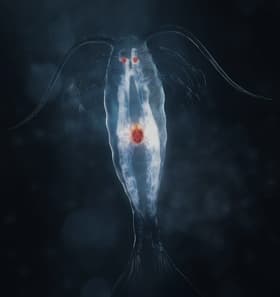
This wealth of plant life in turns supports quantities of tiny drifting animals (zooplankton) which feed upon the drifting plants. Some of these are ultimately swept across coral reefs.
Thus, along with the nutrients supplied by producers that reside within the coral reef biome, the reef community also relies heavily upon tiny zooplankton suspended in the constant flow of sea water that bathes coral reefs.
It is through capture and ingestion of these creatures by myriad coral reef invertebrate animals (including corals themselves) and plankton-feeding reef fishes that some of the organic production of the open ocean is transferred to coral reef food webs.
Primary Consumers: The Herbivores
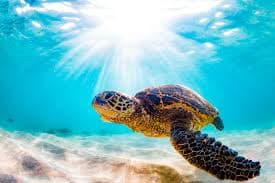
A wide variety of herbivorous animals reside on coral reefs, including invertebrates (such as mollusks and echinoderms) as well as fishes.
Among coral reef resident fishes, three diverse and common families have many plant-eating species. These are the parrotfishes, surgeonfishes, and damselfishes.
Secondary Consumers: The Carnivores
We include here animals that prey upon reef-dwelling herbivores as well as those that feed upon incoming zooplankton.
Invertebrate animals that feed as carnivores in the coral reef biome are extremely numerous and abundant, and include all those that feed primarily on passing zooplankton.
This group alone contains a huge diversity of animal species, including most notably the corals and other cnidarians (anemones). A sizable number of reef fishes also are primarily plankton-feeders.
The overall energetic contribution of zooplankton to coral reef communities is variable in both time and space, and is difficult to measure. Nonetheless, reef planktivores have been shown to be highly efficient, removing as many as 60-70% of the drifting animals from the passing water.
The overall contribution of zooplankton to coral reef food chains is therefore believed to be substantial.
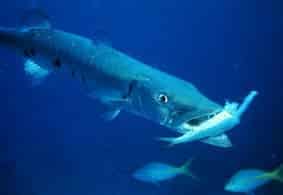
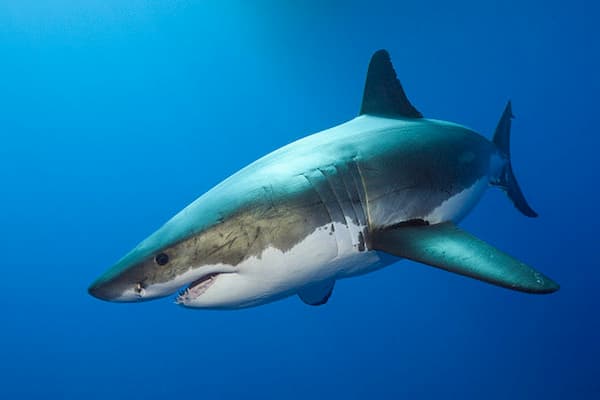
The largest carnivores that dwell on coral reefs are the piscivores - those fishes that feed heavily upon herbivorous and planktivorous fishes.
These include (most notably) barracuda, sharks, large seabasses (groupers, hinds), trumpetfishes, and large snappers.
Summary: The Coral Reef Food Web
Coral reef communities are extremely efficient at acquiring, retaining and recycling nutrients received from multiple sources.
The key elements in the coral reef recycling process are (1) the symbiotic relationship between hard corals and their zooxanthellae, and (2) the rapid and effective exchange of nutrients and energy between different parts (zones) of the coral reef biome.
It is the sum of organic contributions from myriad sources both from within the coral reef biome itself as well as from neighboring biomes - along with a highly efficient "recycling program" - that allows for the sustenance and growth of coral reefs in the midst of waters so stripped of dissolved nutrients that they are often referred to as biological deserts.