|
Coral
Reef Info |
![]() |
|
Bonaire DivingBonaire diving has long been recognized by scuba enthusiasts as one of the best places to visit in the entire Greater Caribbean region. The island of Bonaire is part of the southern group of the Netherlands Antilles, situated about 80 miles to the north of Venezuela. It is a low and relatively flat island with a surprisingly (for the Caribbean region) arid climate and semi-desert landscape. Much of Bonaire's coast consists of beautiful coral sand beaches that frame the narrow belt of turquoise shallow waters immediately off shore, eventually giving way to the deep blue Caribbean. Because of its extreme southerly location in the Lesser Antilles, Bonaire and its neighboring islands of Aruba and Curacao are rarely subjected to the effects of the hurricanes that frequently plague more central and northern parts of the Greater Caribbean region during the summer months. Bonaire Coral Reef Diving EnvironmentBonaire is almost completely surrounded by a narrow but very well-developed fringing reef system that begins in many places near the shore and extends to a maximum of about 300 meters offshore. Since 1999, the entire coral reef ecosystem has been protected as part of the Bonaire National Marine Park, a government decision that is in no small part responsible for the sustained high quality of Bonaire diving.
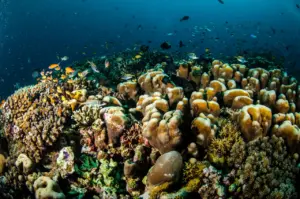
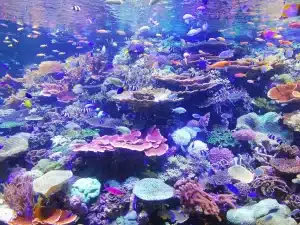
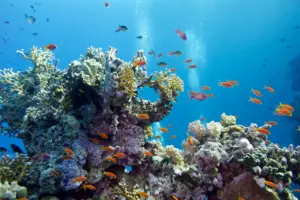
Shallow Bonaire diving environment. © Fotolia.com
Because of low rainfall on the island, its surrounding waters are exceptionally clear, with visibility generally in the 100-150 ft. range. Water temperatures average about 78-84°F. The leeward (western) side of the island is relatively calm all year, but the windward side is sometimes exposed to heavier wave impact and conditions there are less predictable. The structure of the reef system along the leeward side of the island (where most of the recreational Bonaire diving occurs) makes for an interesting variety of diving opportunities. From the shore, a shallow gently sloping terrace extends about 30 to 150 yards seaward. Depths here range to a maximum of about 30-50 ft., making for excellent shallow water diving. The dominant hard corals in this area are branching forms (Acropora spp.) and smaller colonies of boulder corals. Unfortunately, many of the branching colonies have undergone severe damage over the last few years due to several unusual (for this island) hurricane strikes. In some places, these once lush thickets of living coral have been reduced to pockets of bleached remains.
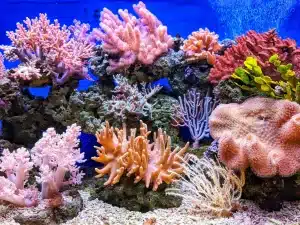
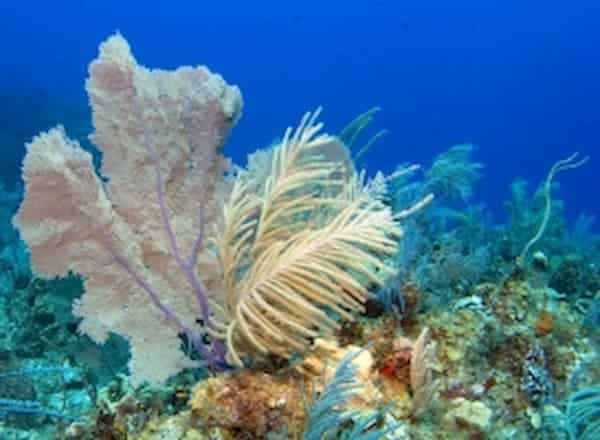
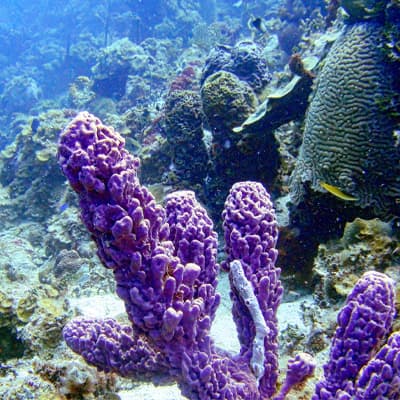
Sponges and octocorals of Bonaire back reef. © Fotolia.com
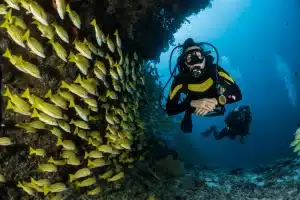
The smaller formations of boulder corals have faired much better, and large sponges and octocorals remain abundant, as do the many types of fishes common to the inshore habitat (see photo, right). At the outer margin of this inshore platform, a steep and well-developed reef face begins its descent into deeper water. Here is where the greatest number of coral and fish species are found. As depth increases further, larger formations of boulder corals and eventually plate-like coral forms dominate. The fore reef terminates in flat sand plain at about 150 ft. Bonaire Travel InformationKLM/Air France offer direct flights to Bonaire from Amsterdam on a daily basis. Delta flies direct from Atlanta and from New York (JFK). Continental flies direct from Newark and Houston. Most of these non-stop flights are weekends only, typically one flight per week. Itineraries consisting of connecting flights can be made almost every day from many U.S. airports, with only one or two changeovers. Bonaire offers a wide selection of lodging to fit all price ranges. Unlike many Caribbean dive destinations, most lodging rates in Bonaire do not fluctuate much seasonally. DIVE CORAL REEFS (CARIBBEAN): SECTION NAVIGATION MENU
Saba Diving | Belize Diving | Bonaire Diving |
![]() ![]() ![]() |
|
|
|
||
|
|
||
|
|
||