Most reef scientists generally recognize three basic types of coral reefs:
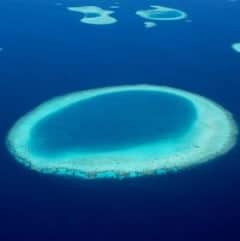
(1) Atoll - a roughly circular (annular) oceanic reef system surrounding a central lagoon
(2) Fringing Reef - a reef system that grows fairly close to (or directly from) the shore, with an entirely shallow lagoon or none at all
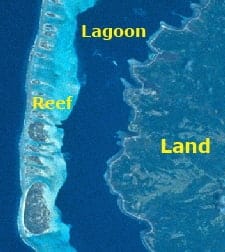
(3) Barrier Reef - a reef system that parallel the shore and is separated from it by a wide lagoon that contains at least some deep portions
The differences between these three main reef types are often quite pronounced in terms of large-scale structural features.
Nonetheless, there is often a good deal of similarity between them within a given biogeographic region in terms of the dominant groups of animals and plants, as well as their ecological interactions.

Development Of Major Reef Types
The basic coral reef classification scheme described above was first proposed by Charles Darwin, and is still widely used today.
Darwin spent most of his coral reef explorations in the Indo-Pacific region, and viewed the three types of coral reefs he described as simply different stages in the geological 'evolution" of Pacific oceanic islands.
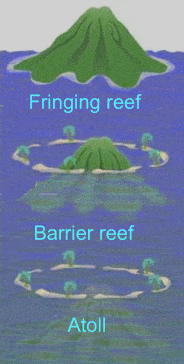
Darwin theorized that fringing reefs began to grow near the shorelines of new islands as ecological conditions became ideal for hard coral growth.
Then, as the island began to gradually subside into the sea, the coral was able to keep pace in terms of growth and remained in place at the sea surface, but farther from shore; it was now a barrier reef.
Eventually, the island disappeared below the sea surface, leaving only the ring of coral encircling the central lagoon; an atoll had formed (see diagram, left).
Darwin's general "reef evolution" theory was finally verified for Indo-Pacific reefs in the early 1950s after analyses of the results of deep core drilling at Bikini and Eniwetok Atolls.
However, it has also now become apparent that each of these three types of coral reef can, in some instances, also be formed by different processes as well. This is clearly the case with most of the relatively few true atolls that occur among Caribbean coral reefs.
A Note On Patch Reefs
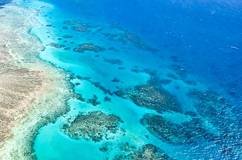
The term "patch reef" is commonly used to refer to comparatively small, isolated outcrops of coral surrounded by sand and/or seagrass (see photo, below).
While patch reefs have sometimes been described as a fourth "coral reef type", such comparisons are clearly not appropriate.
Rather, patch reefs are more properly considered regular microscale reef features of all three of the macroscale reef types first described by Darwin - fringing reefs, atolls and barrier reefs.
In the sense that Darwin described coral reefs - the same reef classification system widely in use today - patch reefs are not remotely comparable to the major coral reef types, and should not be confused with them.
Return To Coral Reef Home Page