How Are Coral Reefs Formed?

How are coral reefs formed? This is an intriguing question that scientists have asked for hundreds of years, and the answers continue to be refined even today.

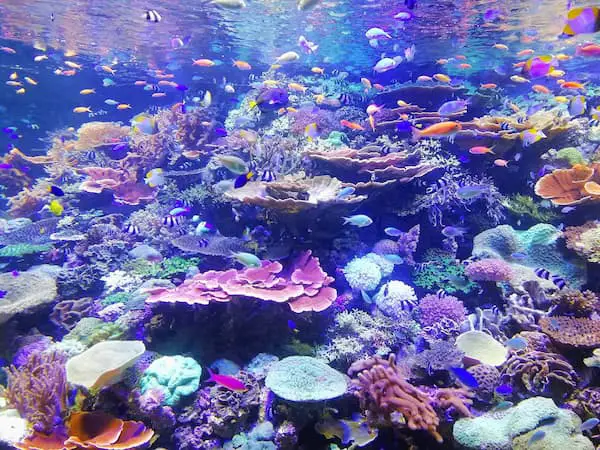
a shallow coral reef in the Caribean

Coral reef structure often seem infinitely variable, particularly from the relatively small scale perspective of a person observing reef environments at close range, as would a scuba diver or snorkeler.

Yet many or most coral reefs within the larger regions of coral reef development share a surprising degree of similarity in terms of basic reef types and ecological interactions. The formation of coral reefs is an ancient and complex process involving numerous kinds of marine life, along with a variety of physical forces and processes.

Thus, to fully answer the question, "how are coral reefs formed?" we must look in turn at each of the main biological components of the coral reef biome, along with the processes that allow these life forms to build such imposing structures.


The Coral Animal

Although a wide variety of marine creatures ultimately contribute to the complexities of coral reef structure, most of the reef's underlying solid framework is constructed by the slow, cumulative efforts of just one particular group of simple, tiny animals called the hard (Scleractinian) corals.

close up photo of hard coral polyps with tentacles exposed

Close up view of hard coral polyps with tentacles extended. Photo: Courtesy NOAA

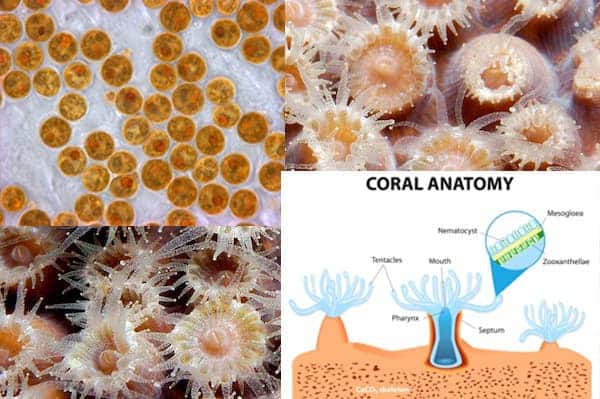
In these animals, the body of each individual (called a polyp) is encased in a hard external skeleton composed of calcium carbonate formed by the animal itself from substances extracted from seawater.

A most unusual and advantageous aspect of hard coral biology is that their body tissues serve as a home for numerous, tiny algal plant cells called zooxanthellae.

These essential biological partners (symbionts) provide the coral polyp with vital nutrients produced through photosynthesis. In return, the plant cells gain the benefit of a ready source of otherwise scarce nutrients which are produced by the polyps' metabolism.

xoozanthellae living within the tissues of a coral polyp

Zooxanthellae as seen through a microscope. Photo: Courtesy Scott R. Santos, Dept. of Biological Sciences, Auburn University, Auburn, AL USA.

In truth then, hard corals are composite organisms, part animal and part plant; and this is in no small part a reason for their tremendous success in waters where dissolved nutrients are far from plentiful.

Coral polyps also satisfy their nutritional requirements by feeding on tiny planktonic creatures suspended in the water column. These are captured by the specialized feeding tentacles and passed to the gut for digestion, with the resultant nutrients shared by the plant cells.

In most hard coral species the tentacles are used only at night, when they are relatively safe from hungry reef fishes. During daylight hours the tentacles are retracted into the safety of the protective skeleton.


Coral Colonies

As adults, hard coral animals exist as parts of large cohesive assemblages called colonies, in which only the outermost layer is composed of living polyps.

Each coral colony is composed of many genetically identical individual polyps, with succeeding generations built upon the skeletal remains of their forbearers. Occasionally, isolated colonies of hard coral may be found, but far more typically they grow in larger assemblages that we call coral reefs, composed of many colonies of the same or different species.

Hard coral colonies generally exhibit one of three basic growth forms: massive, branching, or plate-like, although some species form colonies that do not readily fit into any of these 3 general categories.

massive growth form of hard coral colonies branching growth form of hard coral colonies plate-like growth form of hard coral colonies

Massive (left), branching (center) and plate-like (right) are the most common growth forms of hard coral colonies.

Also, the shape, size, and color of coral colonies are subject to modification by local environmental conditions such as wave action, currents, prevailing winds, etc., often leading to substantial variablity in the appearance of colonies of the same species.

Thus, while most hard coral species may usually be readily recognized by the characteristic appearance of the colony, identification in some cases requires close and careful scrutiny of the form and pattern of the individual polyps that make up the colony's surface.


Coralline Algae

encrusting coralline algae grows upon a reef surface

A key part of answering the question "how are coral reefs formed?" lies in the fact that growing upon and amidst the coral colonies are an unusual group of plants, called coralline or calcareous algae. These, like the hard corals themselves, also incorporate calcium carbonate into their bodies, thereby playing a pivotal role in helping to build and cement the reef into a strong cohesive structure.


Other Contributors

Species of another quite different type of coral (Millipora spp.) commonly known as the fire corals also contribute to the framework of many shallow reefs of both the Indo-Pacific and Greater Caribbean regions.

Upon the solid structural foundation built mainly by hard corals and calcareous algae grows a superficial layer of sponges, octocorals, less conspicuous kinds of invertebrate animals and some types of algae. Together, these other types of living things provide a substantial added dimension of structural and biological complexity and diversity to coral reefs.


So, How Are Coral Reefs Formed?

To answer the basic question "how are coral reefs formed?" then, we must consider a host of factors.

First, we must consider the unusual properties of the hard coral polyps and their symbiotic algae that comprise the basis for coral reef formation.

Second, we must also take into account the contributions of a few other specialized types of marine life that contribute to reef building, along with a host of other types of plants and animals that contribute to reef complexity and diversity.

And finally, we must understand the nature and impact on coral reef growth of dynamic processes that originate within the ocean, atmosphere, and the earth itself.

Only then do we gain a real appreciation of "how are coral reefs formed", and how they vary in time and space.


Custom Search


HOME

Coral Reef Basics
What Are Coral Reefs?

Coral Reef Distribution

How Reefs Are Formed

Types of Coral Reefs

Coral Reef Biome


Coral Reef Life
Coral Reef Fish

Coral Reef Animals

Coral Reef Plants

Coral Reef Food Web


Coral Reef Diving
Dive Coral Reefs

Caribbean Diving

Bahamas Diving

Pacific Diving


More Resources
Best Coral Reef Books

Advertise With Us | Contact Us | Privacy Policy | About Me | Site Map

Copyright 2009-2010. Coral-Reef-Info.COM. All Rights Reserved.